Bigger is better? iPhone 15 Pro vs iPhone 15 Pro Max
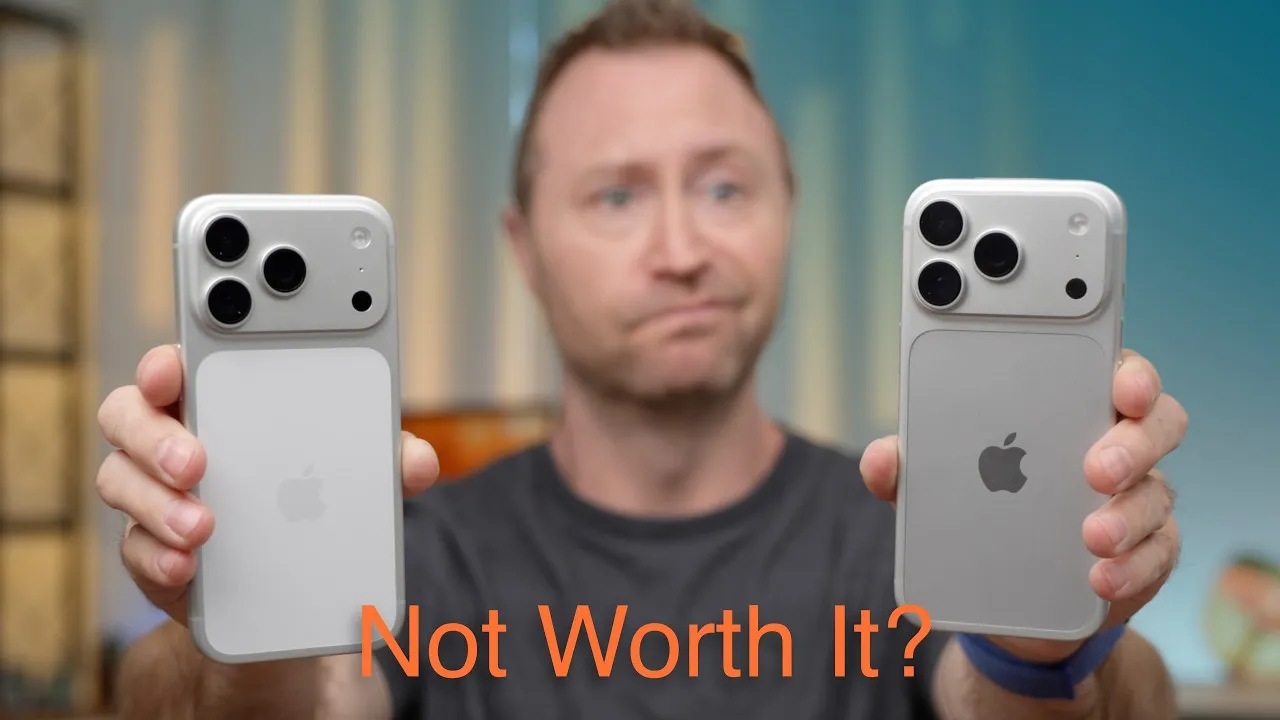
I compared the new iPhone 15 Pro and 15 Pro Max, which are the same in many ways and different in a few. I have the 15 Pro in White Titanium and the Pro Max in Natural Titanium, both 256 GB.
Price
The 15 Pro starts at $999 for 128 GB and the Pro Max at $1,199 for 256 GB. So when you spec the Pro to 256 GB, the difference is only $100. Both go up to 1 TB.
Design
Titanium goes all the way around, replacing the heavy stainless steel, with a brushed matte finish instead of the very shiny steel. You can get Natural, Blue, White or Black. The Natural and White are extremely hard to tell apart in most lighting; the Natural just has a very slightly different tint.
The edges are rounded, which feels better. I was skeptical, since I never minded sharp edges, but compared with a 14 Pro Max, the feel is a lot smoother and more comfortable. Weight is down about 10% by Apple’s number, and it feels lighter than that.
- Weight: 15 Pro Max 7.81 oz; 15 Pro 6.60 oz.
- Depth: the same, 8.25 mm. The Pro is about 6 mm narrower, and the Pro Max about 13 mm taller.
The Action button
A customizable button replacing the mute switch: set it to open the camera, turn on the flashlight, voice memo, accessibility settings, or run any Shortcut. In Settings → Action Button you swipe through the options. I set it to the camera: press and hold from the lock screen to open it, and use it to take photos too.
ESR sponsored this video, with its Stash Stand cases: the Classic Hybrid (military-grade protection with Air Guard corners, a raised display edge and camera guard, and a thinner back for faster MagSafe charging) and the Cloud Soft Case (a rigid core with silicone outside and a microfiber lining). Both have a flip-out kickstand for landscape viewing, including while charging with MagSafe, and 1,500 grams of magnetic force for MagSafe accessories. ESR also has the Armorite glass screen protector, which can sustain a 110-pound pinpoint force test.
Displays
Basically last year’s, which is great. Super Retina XDR, 6.7 inches (Max) and 6.1 inches (Pro), both with the Dynamic Island, 2,000,000:1 contrast, 1,000 nits typical, 2,000 nits in the sun (“awesome for the couple of minutes or seconds it works”), and 1,600 nits for HDR. Both have ProMotion and always-on.
USB-C
The big change. It replaces Lightning from 2012, and on the Pro models supports up to 10 Gb/s: external hard drives, an HDMI cable to a monitor or TV, SD card or Ethernet adapters, and external USB-C cameras. Some will be upset about buying a new cable, but you probably already have USB-C cables for other devices, and I think everybody will be happy long-term.
A17 Pro
A 6-core CPU (2 performance and 4 efficiency cores), 6-core GPU and 16-core Neural Engine. In Geekbench 6, the two are within a margin of error: single-core within one point of each other and a couple of percent apart in multi-core, and graphics similar too. The larger device doesn’t score better. Apple says about 10% over the A16, and my 14 Pro showed about 10% lower single-core. The big GPU change is hardware ray tracing, which should bring console-level gaming to games eventually.
Wireless
Both have the second-generation Ultra Wideband chip (Apple doesn’t call it U2), for Find My with AirTags, your Apple TV remote and finding friends precisely. Both have 5G, Wi-Fi 6E and Bluetooth 5.3. On my 6E access point and 10 Gb network, the 15 Pro got about 415 Mb/s, the Pro Max 472 Mb/s, and the Pro again 478 Mb/s: wireless is variable, so don’t read too much into it.
Battery
Video playback up to 29 hours for the 15 Pro Max (like the 14 Pro Max) and 23 hours for the 15 Pro. I haven’t done tests yet, so ignore anyone giving you actual numbers this early. Last year, with the 14 Pro Max, I used over six hours of screen time and ended with about 20–40% left. On the 6.1-inch 14 Pro, I got about 5½ hours and ended with 5–30%. I’d expect similar this year.
Speakers and cameras
Speakers: not expecting much change from last year; I recorded an audio test.
Cameras: both have a 48 MP main sensor shooting 24 MP photos by default, and the same 12 MP ultra wide. The 15 Pro has the 3× camera from last year’s 14 Pro Max. The Pro Max has the new 5× Tetraprism lens with a new optical stabilizer, which reaches noticeably further (the Pro only goes to 3×).
The 1× camera is a 24 mm equivalent, with 28 mm, 35 mm and 2× sensor-crop presets. Portrait mode is now automatic, capturing depth so you can edit later. No more “oh crap, I forgot portrait mode.” It’s on the regular 15, too.
You can now record ProRes Log, a flat profile for color grading: up to 4K 30 on the phone, and 4K 60 on external storage thanks to USB-C. The front camera is the same as last year.
Which one?
It comes down to one thing: size. The Pro Max is the better device, with a bigger screen, bigger battery, better zoom lens and 256 GB base storage, but it’s big, and it took me a while to get used to it. If you prefer a smaller device that fits your hand and pocket, and can live with a battery that may not last a crazy-long day and 128 GB base storage, the 15 Pro at $999 is a good buy.
Links
- ESR Classic Hybrid Case with Stash Stand
- ESR Cloud Soft Case with Stash Stand
- ESR Armor Tough Case with Stash Stand
- ESR Armorite Screen Protector
- ESR MagSafe Lineup
- Buy the iPhone 15 Pro Max
- Buy the iPhone 15 Pro
- iOS 17 - Top 5 Features!
- wallpaper1 by Ben Phillips from Pexels
- Wallpaper2 by Gezer Amorim
- https://twitter.com/jerryschulze
- https://www.threads.net/@jerryschulzeonyt
- https://mastodon.world/@jerryschulze
- https://bsky.app/profile/jerryschulze.bsky.social
In this video
Some links in this post are affiliate links, which means that if you click on one of the product links, I may receive a small commission. See my ethics statement.