Apple Studio Display Copied!
This might look like the Apple Studio Display, but it’s the G27P from a company called Kuycon. For a few years they’ve made displays that mimic the Studio Display and Pro Display XDR, and I’ve been really impressed with this one over the last few weeks.
This video was sponsored by TORRAS.
Price
It starts at $799 for the flat-back model, or $899 for the version with Pro Display XDR-style cutouts. That doesn’t include a stand: the basic stand is $109 and the height-and-tilt stand is $189. My flat-back display plus adjustable stand runs almost $1,000, or a little under $900 bundled. A VESA mount is included in the box.
Specs
5K (5120 × 2880), listed at 60 Hz, 99% DCI-P3, 600 nits peak. Where it differs from Apple’s: a claimed 2000:1 contrast ratio and HDR support.
Design
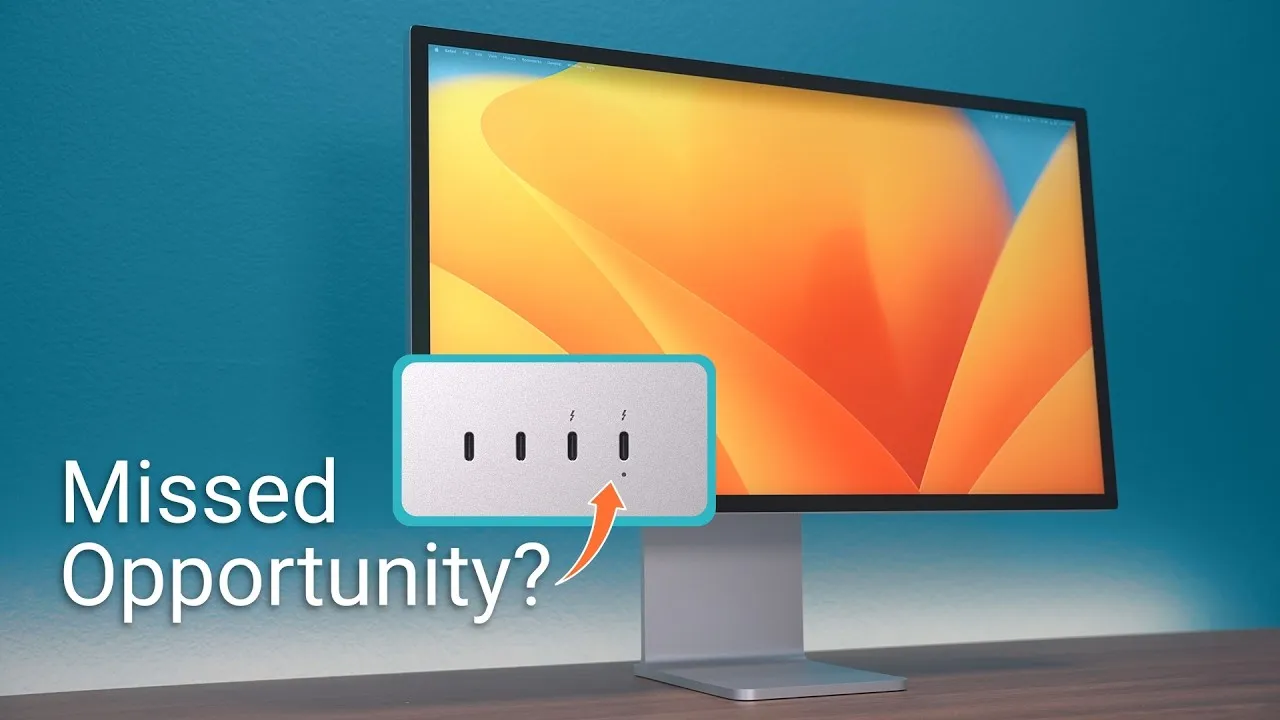
Of all the new 5K displays I’ve looked at, this is by far the best aesthetic design besides the Studio Display. From the front it’s simple silver and black: no logos, no buttons, uniform bezels (I prefer thicker uniform bezels over thinner ones). The display and stand are big blocks of aluminum. It’s not Apple fit and finish, and it isn’t unibody (there’s a seam where the back panel sits in the frame), but it’s so much better than creaky plastic. The only button is power, underneath.
The stand adjusts height and tilt and rotates 90°, and it moves less than nearly every display I’ve tested, with chamfered edges around the cable hole. Two nitpicks: that cable hole is a bit low, so you’ll see cables unless the display is low, and the height mechanism makes a terrible grinding noise. Set it once and it stays put.
Ports
USB-C (display input), HDMI 2.1, and DisplayPort 1.4 on the back, with a remote to switch inputs and adjust picture settings. Two USB-A ports and a headphone jack on the side. All the USB ports run at USB 2.0 speeds, so they’re really just for a mouse or keyboard dongle.
The panel
I was blown away. It’s glossy like the Studio Display, and everything looks the way it’s supposed to: bright, not oversaturated, accurate to years of using a Mac. By eye I saw no real uniformity problems, just one small dark band during a solid-color test. Backlight bleed wasn’t perfect, but better than the ASUS 5K. Movies with lots of dark in the frame look great thanks to the higher contrast. It isn’t OLED, but it’s much better than the 1000:1 of most IPS panels.
Surprise: in the HDR settings I found it actually runs at 75 Hz, not 60. Maybe a little less motion blur, a little smoother. HDR itself? Maybe a little effect, but with no local dimming, you’re not getting real HDR from an IPS panel.
My calibrator results, Kuycon versus the Studio Display:
- P3: 99% vs 99%
- Adobe RGB: 97% vs 88%
- Brightness: 704 nits vs 574
- Contrast: 1610:1 vs 960:1
- Delta E: 0.91 vs 0.68. Both basically reproduce colors exactly.
It’s not all roses. The tool picked up big brightness variation across the panel, up to 29% from one corner to another, versus about 12% on the Studio Display, even though it looked uniform to my eye. Its anti-glare coating also doesn’t block reflections as well as the Studio Display’s.
Mac integration
No speakers, no webcam, no built-in brightness control. The free MonitorControl utility lets you use your Mac’s brightness keys. Sleep and wake are really fast, faster than just about anything but the Studio Display.
The catch: support
You can’t just buy this at Amazon or B&H. I got my review unit from ClickClack.io, which sells it for $799 with a one-year warranty, but the brand is Kuycon, there’s a separate Kuycon.us site with a slightly different name and specs, and sometimes the photos don’t match. If you have a problem later, I honestly don’t know who you’d contact. I found a lot of positive reviews, including people with good return experiences through ClickClack, and I’ve had zero issues. But long-term support might be a slight gamble.
Overall: a beautiful design, solid build, an accurate screen, and a great picture that I enjoy using.
Links
- shop on amazon for OFitness
- shop on Website for OAir
- Kuycon G27P
- Asus ProArt PA32UCDM
- BENQ PD2730S
- Studio Display
- Asus PA27JCV
- BenQ MA270U
- Samsung ViewFinity S9
- Affordable 5K Display for Mac: ASUS ProArt PA27JCV
- The Everyday Mac Display - BENQ MA270U
- Samsung ViewFinity S9 5K vs Apple Studio Display
In this video
- 0:00 Not the Studio Display
- 0:28 pricing
- 1:01 stand or vesa
- 1:33 specs
- 2:02 dressed to impress - design and stand
- 3:51 nit picks
- 4:29 Torras Ostand Fitness
- 5:49 ports and remote
- 6:30 color, backlight bleed, and uniformity
- 7:54 HDR and 75hz!
- 8:46 checking with a calibrator
- 10:12 some display concerns
- 10:55 glossy and antiglare
- 11:14 integration with macOS, sleep/wake, speakers webcam
- 11:59 vs studio display, asus, and benq
- 13:00 something to consider
Some links in this post are affiliate links, which means that if you click on one of the product links, I may receive a small commission. See my ethics statement.