iPhone 16 Pro Max vs iPhone 14 Pro Max
Have an iPhone 14 Pro Max and wondering whether to upgrade to the iPhone 16 Pro Max? I compared everything: design, display, speakers, cameras and more.
Design
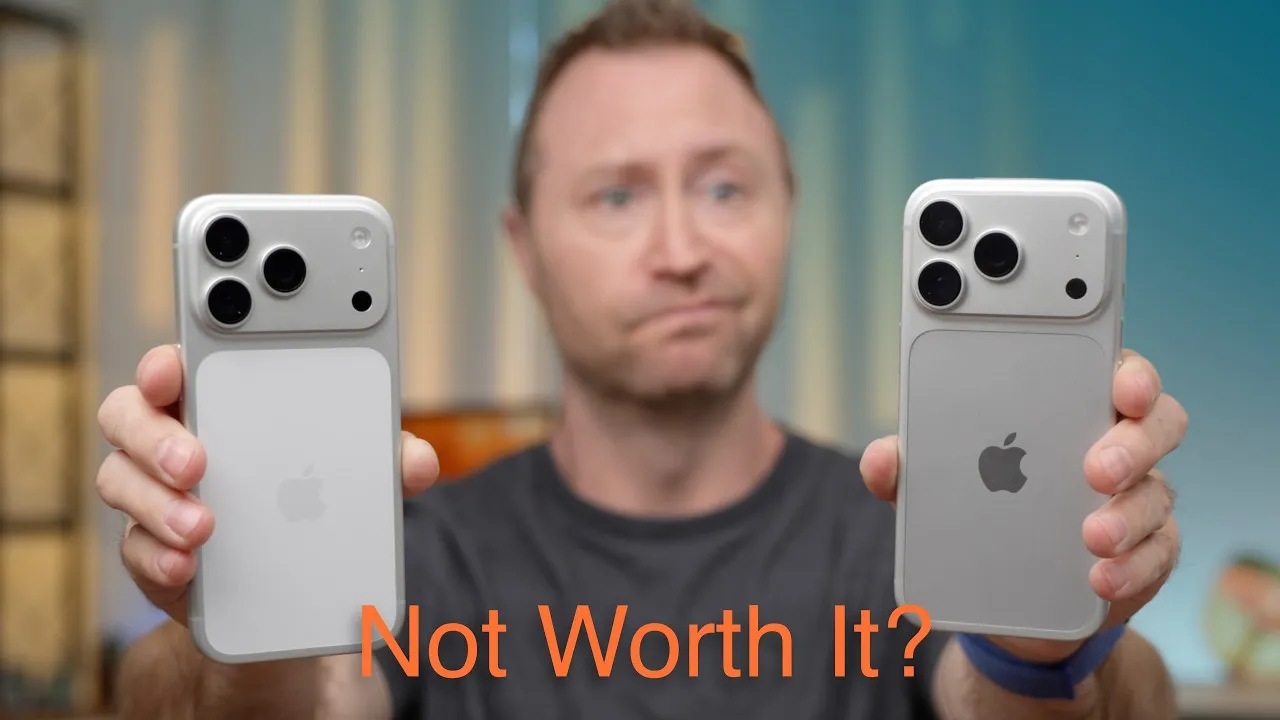
Since the iPhone 12 in 2020, they basically look the same, but there are differences:
- Frame: the 14 Pro Max is shiny polished stainless steel that picks up fingerprints; the 16 Pro Max is titanium with a matte finish that hides fingerprints and is easier to clean. Its slightly rounder edges are more comfortable to hold without a case.
- Size and weight: both are 77 mm wide; the 16 Pro Max is 163 mm tall versus 160 mm, because of its bigger screen. Yet it’s lighter: 227 g versus 240 g.
- Ports and buttons: USB-C instead of Lightning, the Action button instead of the mute switch, and Camera Control where the 14 Pro Max has its 5G antenna window.
I like both designs. If you have a Deep Purple 14 Pro Max, though, the 16 Pro Max’s white, black and two grayish colors may disappoint.
Torras sponsored this video, with its O-Stand 360 Spin case and Glass Go X screen protector.
Display
Very little difference: a 6.7-inch versus 6.9-inch Super Retina XDR OLED, both with 120 Hz ProMotion, always-on display, 460 ppi, 1,000 nits typical, 1,600 HDR and 2,000 outdoors, and the Dynamic Island. The 16 Pro Max can also dim to 1 nit, nicer on your eyes in the dark and less distracting to people around you.
USB-C
One of the biggest advantages. With Lightning, you need different adapters for everything. With USB-C: HDMI in a hotel room, getting ProRes video off quickly, connecting cameras, microphones and accessories, and traveling with one cable for all your devices. If you consider yourself a pro iPhone user, you’ll appreciate it.
Action button
My opinion has gone back and forth. Removing the mute switch seemed odd at first. Some people build big Shortcut menus, which I find overwhelming; why not just open the app? I tried the camera, but there are many ways to open it. I settled on the flashlight, which I use multiple times a day, from looking under the couch for the remote to checking out a weird mole on my butt.
Cameras
I’m not a pixel peeper, but sometimes a new camera feature is a must-have, like the 5× tetraprism zoom from the 15 Pro Max. It gave me usable videos of my daughter’s volleyball games, where you can see faces and expressions instead of blobs flopping along a gym floor. The 14 Pro Max’s 3× lens couldn’t capture that.
- 48 MP ultra wide: sharper on a fire hydrant down an Austin street (the 14 Pro Max was accidentally set to a cool tone), but in a macro of a tiny flower bud I saw little difference.
- Main camera: both 48 MP at 24 mm, and I have a hard time seeing a difference beyond small shifts in white balance or brightness, which happen between any two shots.
- Fusion camera: the 16 Pro Max crops the sensor for 24–48 mm shots without digital zoom, something it seems the 14 Pro Max should be able to do in software, but no.
- Next-generation portraits: depth captured automatically for people, dogs and cats, so you can change focus and aperture later.
- Photographic Styles act more like a color change to a raw photo than a filter, and you can change them afterwards.
- Video: the 16 Pro Max adds ProRes Log and 4K 100 and 120 fps Dolby Vision slow motion. I could see using that for B-roll, since my big cameras only do 4K 60.
Camera Control is a real button that presses, with haptic light presses for quick controls. As a shutter it works, but I get a steadier shot tapping the screen. Two light presses bring up a menu for aperture, zoom, cameras, styles and exposure, and zooming is pretty smooth.
Speakers
One of the biggest differences. The 14 Pro Max reached about 88 dB versus 83 dB on the 16 Pro Max. Five decibels is a big difference. The 14 Pro Max is much louder and a bit punchier.
Battery and charging
When the 14 Pro Max was new, I got 6–7 hours of screen time with some left at bedtime. Apple rates it for 29 hours of video playback versus 33 hours for the 16 Pro Max, which gets me through a full day of 5–7 hours of screen time with a little left. If your 14 Pro Max’s battery has aged, you’ll see a nice boost. Wired charging is a little faster (about 50% in 30 minutes versus 35), and MagSafe goes from 15 W to 25 W.
Performance
The A16 has a 6-core CPU and 5-core GPU; the A18 Pro has a 6-core CPU and 6-core GPU. Both have a 16-core Neural Engine.
| Test | 16 Pro Max | 14 Pro Max |
|---|---|---|
| Geekbench 6 single-core | 3,315 | 2,651 |
| Geekbench 6 multi-core | 7,999 | 6,487 |
| GFXBench | 28 fps | 22 fps |
Metal graphics were about 42% faster, and 3DMark Solar Bay ray tracing more than twice as fast. In everyday use, you won’t see much difference opening apps or web pages, except maybe in big games with ray tracing. The real benefit is longevity: in five years, the 16 Pro Max will run iOS better.
What the 14 Pro Max will never get is Apple Intelligence: mail and notification summaries, writing tools, and a more conversational, context-aware Siri. Only some of it is even in beta so far.
Wireless
The 16 Pro Max adds a Thread radio for Matter devices (which somehow still don’t matter), a second-generation Ultra Wideband chip for more precise Find My, and Wi-Fi 7 versus Wi-Fi 6. Turning the phones a few degrees changed my results completely; unless you move big files on your home network, Wi-Fi 7 won’t make anything faster.
Should you upgrade?
Probably not. Your 14 Pro Max has the same screen, about the same everyday performance, years of good updates left, no fiddly new buttons, and better speakers. But if you want a bigger yet lighter phone, a newer battery, USB-C, better radios and cameras, the new buttons, and Apple Intelligence, and you find a great carrier deal, go ahead and trade it in.
Links
- @TORRASOfficial Ostand 360 Spin! (sponsored)
- iPhone 16 Full setup and Migration
- Get the iPhone 16/Pro/Max
- CalDigit is my dock partner
- https://www.threads.net/@jerryschulzeonyt
- My iPhone Art
- Grovemade Desk Mat and Knife (save 10% JERRY10)
- UNLIMITED Cloud Backup for your Mac with Backblaze
In this video
Some links in this post are affiliate links, which means that if you click on one of the product links, I may receive a small commission. See my ethics statement.