Apple Studio Display vs Eve (Dough) Spectrum 4K - Best Monitor for Mac?
For years Mac users had no first-party display; now there’s the Studio Display. For the last few months I’ve used the Eve Spectrum 4K (now Dough Spectrum One), which I previously called the best display I’d used with a Mac. This compares them, with the Eve and its stand versus the Studio Display with the height-and-tilt-adjustable stand.
Design
- Eve: an all-black plastic body with a two-piece metal stand and very thin, modern bezels. Minimal and unassuming. It’s about 7/8 inch thick plus another 3/4 inch bulge where the stand and ports attach.
- Studio Display: a silver aluminum body with thicker black bezels, a solid aluminum stand, clean lines and perforations top and bottom, about 3/4 inch thick without the stand.
- Both adjust up and down (uncomfortably low for me, plenty high) and tilt; the Eve also rotates 90 degrees. The Studio’s stand is much more fluid and easier to set exactly, and it’s very stable in every direction, while the Eve sways left and right quite a bit when the desk is bumped.
- Power: the Studio has a built-in supply with a non-removable cable (an issue only if a pet chews it, and then you’d need Apple). The Eve has a hefty external brick on a short cord, so you may need to mount it under the desk, and on my standing desk the power cable has come out of the Eve many times.
Specs
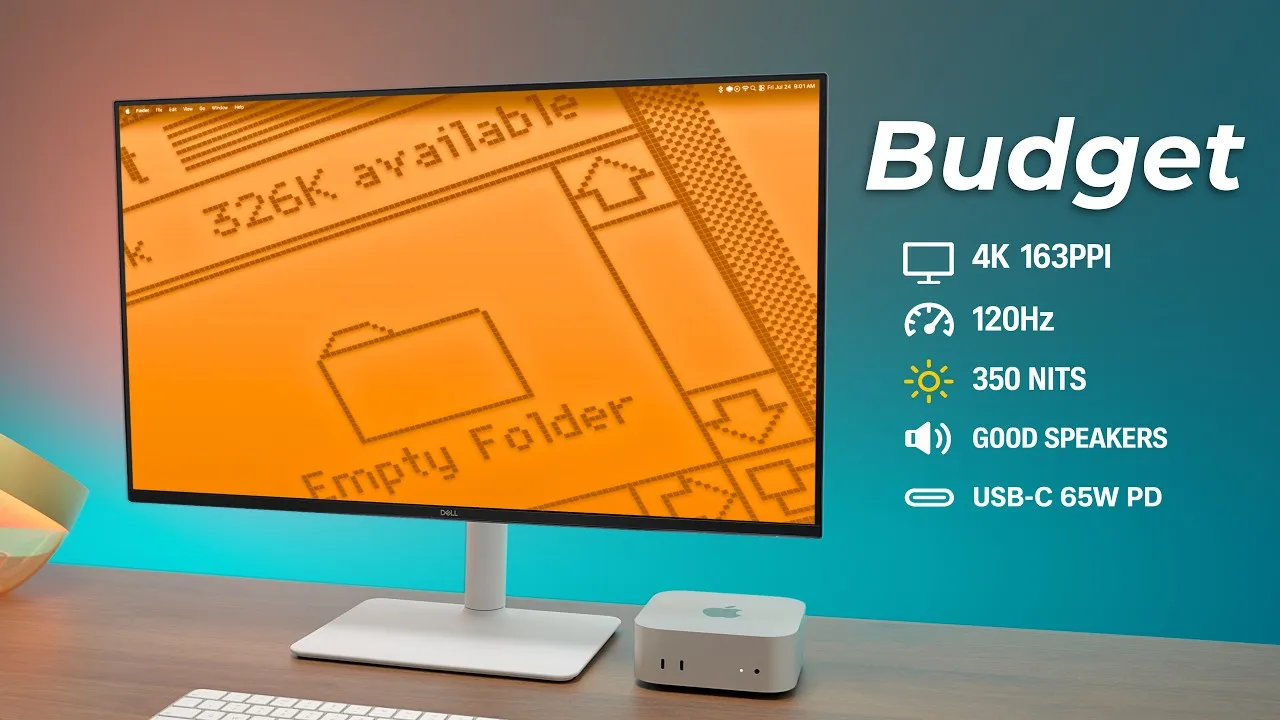
- Eve Spectrum: 4K, 163 ppi, up to 144 Hz, 450 nits (up to 750 nits in HDR), P3 color.
- Studio Display: 5K, 218 ppi, 60 Hz, 600 nits, P3 color and True Tone.
Both scaled to 2560 by 1440, the 5K is sharper (more pixels). You can make the 4K a little sharper at 1920 by 1080 scaling, but everything gets much larger. Eyes vary, and you may not notice, but some people will.
Refresh rate: 60 Hz matches most external displays. High refresh rates are common on phones like the 13 Pro, tablets and gaming monitors. I’m not advocating playing high-intensity games on a Mac, but 144 Hz makes interactions feel smoother: scrolling text stays crisp instead of a blur, and moving the mouse and dragging windows feels good. I notice it instantly on the Eve. The Studio isn’t bad, and won’t feel different coming from an iMac or non-ProMotion display.
Brightness and HDR: in SDR video, the Studio’s 600 nits looks better than the Eve’s 450: brighter, better contrast and, somehow, smoother motion. With HDR on, the Eve loses picture adjustments, but you can see a brighter fire in a Sony HDR sample, with separation between hot yellow areas, which just looks orange on the Studio. The Eve has only 16 dimming zones, so a lit area in a zone lights the zone and limits the benefit; with both backlights on, I find the Studio a bit blacker. In my HDR iPhone 13 Pro video, the Eve looked blown out: pool stone and decking lost character, white pillows had no detail, and so did the white spots on a soccer ball. The MacBook Pro’s Liquid Retina XDR gives much better results.
Ports and features
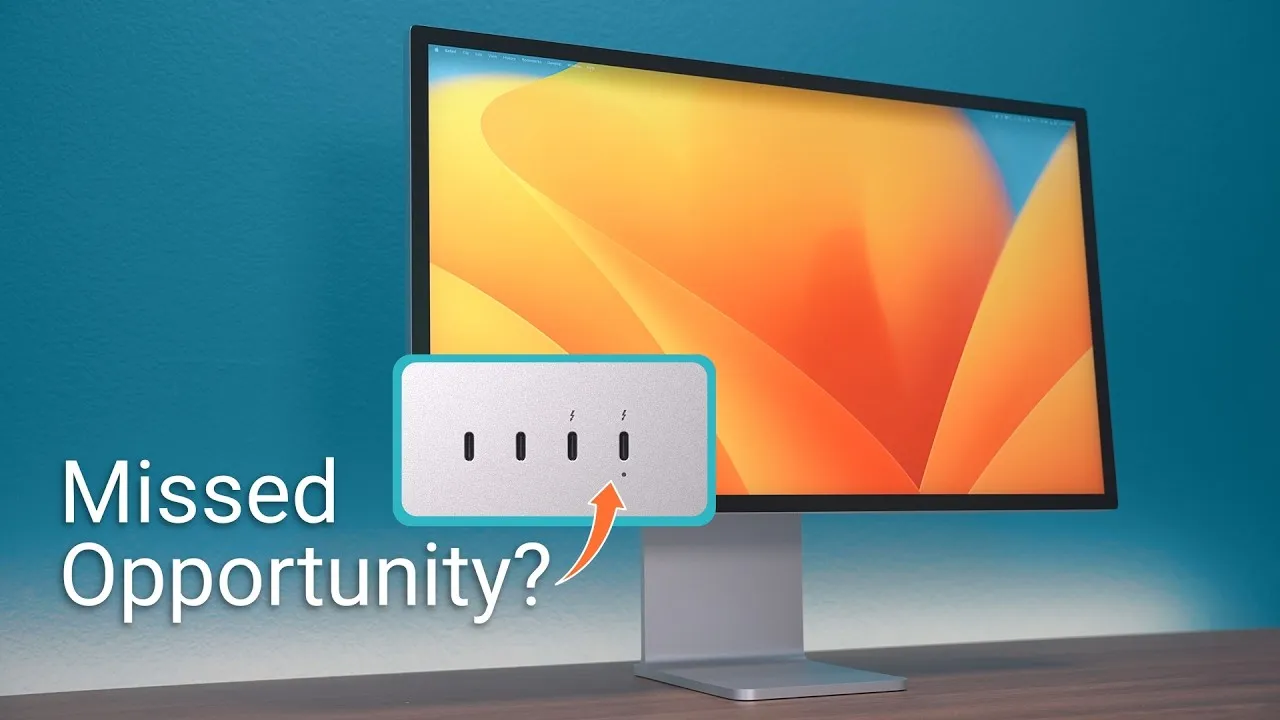
- Studio Display: one Thunderbolt port for the computer and three 10 Gbps USB-C ports. It connects to one device at a time.
- Eve: USB-C input, DisplayPort 1.4, two HDMI 2.1, a 10 Gbps USB-C, two 10 Gbps USB-A, a 10 Gbps USB-B and a 3.5 mm headphone jack. Better for multiple computers or a game console.
- Power to a laptop: up to 100 W on the Eve and 96 W on the Studio.
- The Studio has built-in speakers (really good), a camera (with issues) and mics (acceptable): an all-in-one solution for a minimal setup. It also has better macOS integration: brightness and volume from the keyboard, HDCP streaming content through the single connection and much faster wake time. The Eve is faster for gaming and G-Sync/FreeSync compatible. I’m surprised neither Apple product has an easily accessible headphone jack.
Price
- Eve (4K, 144 Hz): $800 plus $100 for the stand (or no stand for a VESA mount). Matte by default; glossy is $100 more.
- Studio Display with the height-and-tilt stand: $2,000, or $400 less with a tilt-only stand or VESA mount. Glossy by default; nano-texture glass costs $400.
- The Eve’s box has just a power brick. The Studio’s has a non-removable power cord and a braided Thunderbolt 3 cable Apple sells for $130.
Support and availability
The Studio Display may take months to arrive, but I’m confident you’ll get it. Eve has a long history of failing to fulfill orders (I cover it in my earlier Eve video), so you may order with no idea when, or whether, you’ll get one. I finally got mine on eBay. Support is another gap: the button on the back of my Eve broke into two pieces; their support email took a few days to answer, asked for photos, and I’m still waiting, so I’ve super glued it. Apple has a gigantic support apparatus.
Verdict
If you care about the design on your desk, want display quality that matches other Apple displays and built-in features that simplify your setup, I recommend the Studio Display. If you’re more price-conscious, need high refresh rate or want to connect multiple devices to one display, I recommend the Eve. Both are great monitors. Does the Studio justify its price over the Eve for you?
Links
- Buy the Studio Display
- Find Eve (Dough) Spectrum on eBay! (affiliate)
- Eve Spectrum 4k with Mac
- OWC Envoy Pro FX SSD
- Kanto YU2 Speakers
- CalDigit TS4
- iPad Air 5
- AirPods Max
- AirPods Max Stand (ETSY)
- UNLIMITED Cloud Backup for your Mac with Backblaze
- Best Laptop
- Best iPad
- Mac Studio
- Studio Display
- Bamboo Monitor Stand
- CalDigit TS4
- Synology NAS
- RocketQ NVME SSD
- ACASIS NVME enclosure
- OWC Envoy Pro FX SSD
- Logitech MX Keys Mini
- Apple Magic Trackpad
- Logitech MX Master 3
- AirPods Max
- AirPods Max Stand (ETSY)
- Kanto YU2 Speakers
- Satechi Magnetic Charger 2-in-1
- If this was helpful I have a tip jar
- My Camera
- Secondary Lens
- Sennheiser MKH-416 mic
- Zoom F6 recorder
- Rode VideoMic NTG
- Used DJI OSMO 3 Gimbal for some shots
- Tascam DR-10L Audio Recorder with Lav
In this video
Some links in this post are affiliate links, which means that if you click on one of the product links, I may receive a small commission. See my ethics statement.